
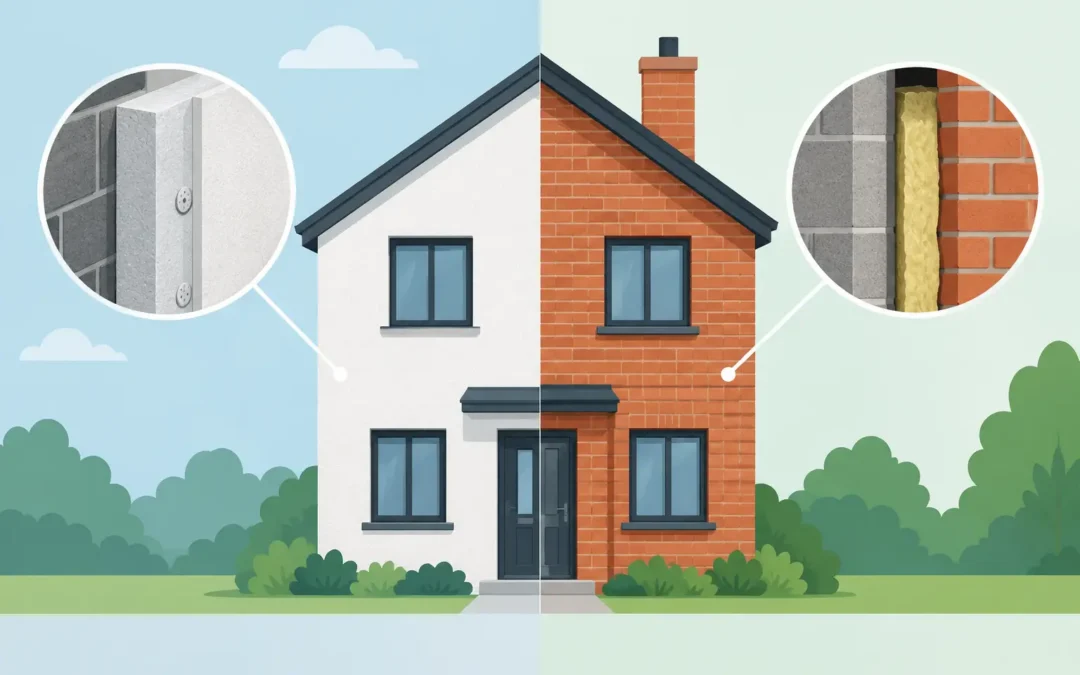
A cold house is not always caused by a lack of heating. Heat can escape through poorly insulated walls, leaving rooms uncomfortable, increasing energy bills and making condensation more likely. When weighing up external wall insulation versus cavity insulation, the right answer depends on how your property was built, the condition of its walls and whether you want to improve the outside appearance at the same time.
For many homeowners, the decision is not simply about choosing the cheapest insulation. It is about selecting a solution that will perform properly, protect the building and suit the work already planned for the exterior.
What is cavity wall insulation?
Cavity wall insulation is installed into the gap between an outer brick wall and an inner block or brick wall. Many homes built from the 1920s onwards have cavity walls, although the width of the cavity and the suitability for insulation can vary considerably.
A specialist drills small holes in the external mortar joints, then pumps insulation material into the cavity. The holes are made good afterwards. It is generally a quicker and less disruptive job than insulating externally, because the existing exterior finish stays in place.
Where a property has a clear, dry cavity and walls in good condition, cavity insulation can be an effective way to reduce heat loss. It can be particularly appealing where the brickwork is sound and the owner does not want to alter the look of the house.
That said, it is not suitable for every building. Exposed properties, homes with driving rain issues, damaged pointing, cracks or existing damp need careful assessment. Filling a cavity without addressing defects first can make moisture problems harder to manage.
What is external wall insulation?
External wall insulation, often called EWI, is fitted to the outside face of the property. Insulation boards are fixed to the walls, then covered with reinforcing mesh, base coats and a weather-resistant render finish. The result is an insulated outer layer that can transform both thermal performance and kerb appeal.
It is commonly used on solid-wall homes, where there is no cavity to fill. However, it can also be considered for cavity-wall properties where the cavity is unsuitable, partly filled, unreliable or where a more comprehensive exterior refurbishment is planned.
The finished system can be completed in a wide choice of colours and textures. For a homeowner with tired pebble-dash, patchy brickwork, old render or a dated frontage, external insulation offers more than warmth. It provides a new, clean exterior at the same time.
External wall insulation versus cavity insulation: the main difference
The most significant difference is where the insulation sits. Cavity insulation fills the gap within a wall. External wall insulation wraps the building from the outside.
Because EWI sits externally, it can reduce thermal bridging around areas such as wall junctions and structural elements more effectively. Thermal bridges are parts of the building where heat finds an easier route out. They can contribute to cold internal surfaces and condensation, particularly around corners, window reveals and floor junctions.
Cavity insulation can still provide worthwhile improvement, but it cannot correct every weak point in the wall construction. Its performance also depends on the cavity being continuous and fully suitable for filling.
External insulation changes the appearance and depth of the outside walls, while cavity insulation is largely invisible once the installation holes have been repaired. That visual difference often becomes the deciding factor for owners planning a render upgrade anyway.
When cavity wall insulation may be the better choice
Cavity insulation may be the sensible option when the walls are in good repair, the property is sheltered enough for the local exposure conditions, and there is a suitable cavity confirmed by survey. It is usually less involved than EWI and does not require alterations to gutters, downpipes, window sills or roof verges.
It also makes sense where retaining an attractive brick façade is important. If the brickwork is a key feature of the property and it does not need repair or rendering, changing the exterior may not be desirable.
For landlords or homeowners looking for a relatively straightforward energy-efficiency improvement, cavity insulation can be a practical route. The important word is suitable. A proper survey should consider the wall type, cavity condition, moisture exposure and any signs of damp before work is approved.
When external wall insulation is worth the investment
External insulation is often the stronger option for solid-wall properties, older homes with uneven or deteriorated facades, and buildings where rendering work is already required. Rather than paying to repair and render a wall now, then considering insulation later, it can be more cost-effective to combine the two jobs in one properly designed system.
It is also useful where the outside wall needs a complete refresh. A quality insulation render system can cover unattractive finishes, protect repaired masonry and give the property a consistent, modern appearance. This is especially valuable for homes where extensions, altered openings or previous repairs have left the external walls looking mismatched.
For properties across Greater Manchester, Salford, Bolton and Bury, weather resistance matters as much as insulation value. The render system needs to be correctly detailed around windows, doors, pipes, sills and roof lines. Poor detailing can spoil the look of the job and create weak points for water ingress.
A well-installed EWI system is not simply insulation boards with render applied over the top. The preparation, fixings, mesh reinforcement, corner beads, movement details and finish coat all matter. This is where specialist workmanship makes a visible and long-term difference.
Practical considerations before choosing
The condition of the walls should come first. Neither insulation route is a substitute for repairing defects. Leaking gutters, cracked render, failed pointing, damaged roof details and rising damp must be investigated before insulation work begins.
With external insulation, you also need to consider how far the new wall finish will project. Window and door reveals may need extending, and existing sills may need replacing or adapting. Rainwater goods, external lights, boiler flues, vents and meter boxes can all require adjustment. These details are manageable when planned properly, but they should be included in the quotation rather than treated as an afterthought.
Planning requirements may apply if the property is listed, in a conservation area, or if the work significantly changes the external appearance. Building Regulations can also be relevant, particularly where a large area of wall is being renovated. A knowledgeable installer can explain what needs checking before work starts.
Internally, external insulation has an advantage because it does not reduce room sizes or force you to redecorate inside. Cavity insulation shares that benefit. Internal wall insulation can be useful in certain situations, but it brings a different set of compromises and is not a direct replacement for either option.
Cost, appearance and long-term value
Cavity insulation is generally the lower-cost intervention, assuming the wall is suitable and no significant repairs are needed. External wall insulation costs more because it involves a full exterior system, more materials, more labour and more detailed finishing work.
However, comparing the two only on the initial price can be misleading. If a property needs old render removed, cracks repaired and a new finish applied, EWI may offer better overall value than paying for exterior repairs separately and leaving the walls uninsulated.
The visual result is another consideration. Cavity insulation preserves the existing façade. External insulation gives you the opportunity to change it completely, with a crisp rendered finish that can make an older home look properly cared for again. For owners improving saleability, tenant appeal or their own enjoyment of the property, that can carry real value beyond energy savings.
Get the survey right before deciding
The best insulation choice starts with an honest assessment rather than a one-size-fits-all recommendation. A good survey looks at wall construction, exposure to weather, current finishes, signs of moisture, external defects and the practical details around the building.
If your cavity is sound and the exterior is already in good condition, cavity insulation may be all you need. If you have solid walls, damaged render or an exterior you want to modernise, an insulation render system could be the more complete answer.
A carefully planned job should leave you with warmer walls, a weather-protected exterior and a finish you are pleased to come home to. That is why it pays to assess the building first, then choose the insulation method that genuinely suits it.
Recent Comments