
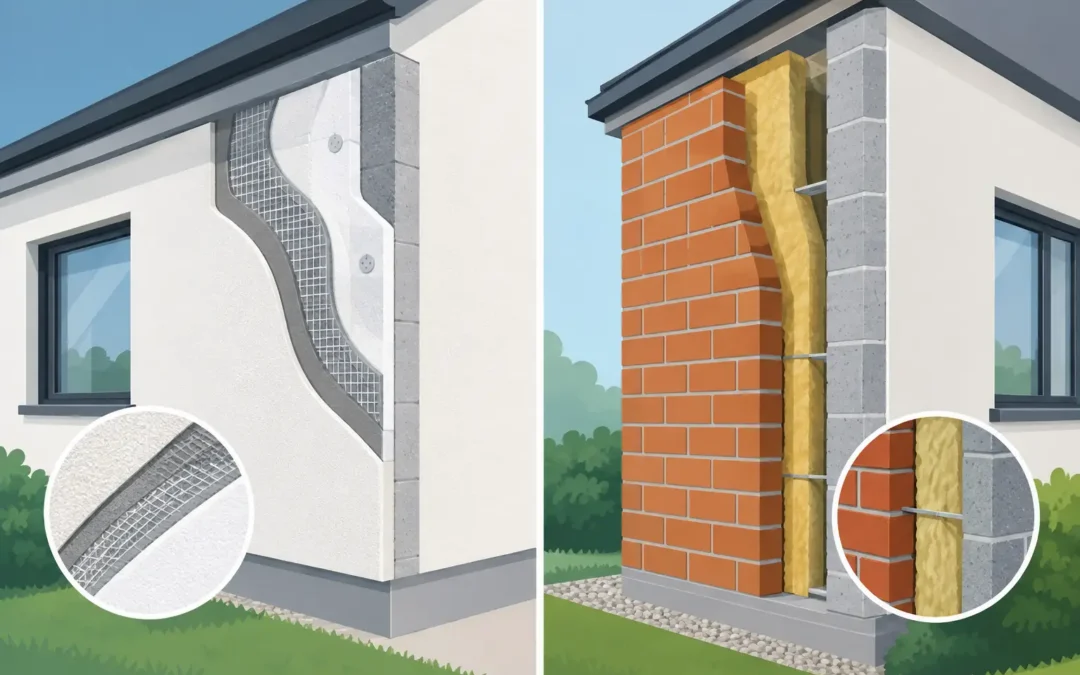
A chilly front bedroom, high heating bills and tired external walls often lead homeowners to the same question: insulated render versus cavity insulation – which is the better investment? The honest answer depends on how your property is built, the condition of its walls and whether you also want to transform its appearance. Both can make a meaningful difference, but they work in very different ways.
What each insulation method actually changes
Cavity wall insulation is installed inside the gap between a property’s outer brickwork and inner blockwork or brickwork. An installer drills small access holes in the external wall, pumps in an approved insulating material and makes good the holes afterwards. It is usually a relatively quick job, with little disruption indoors and no major change to the look of the building.
Insulated render, often called external wall insulation, is fixed to the outside face of the property. Rigid insulation boards are mechanically fixed and bonded to the walls, then reinforced with mesh and covered with a weather-resistant render finish. It changes both the thermal performance and the exterior of the property in one project.
That difference matters. Cavity insulation fills a void that already exists. Insulated render creates a continuous insulating layer around the outside of the home. For a property with dated, cracked or patchy render, that can solve two problems at once: improve warmth and provide a clean, modern finish.
Insulated render versus cavity insulation: the key differences
Thermal performance and cold spots
A properly filled cavity can reduce heat loss through suitable external walls very effectively. It is often a sensible first option for a conventional brick-built home with an empty, dry cavity. However, insulation inside the cavity does not cover areas where heat can bypass the wall construction, such as around floor edges, lintels, reveals and some structural junctions.
Insulated render sits outside the building fabric, helping to reduce these thermal bridges. The existing wall stays on the warmer side of the insulation, which can improve internal comfort and reduce the risk of cold internal surfaces. This is particularly valuable in solid-wall homes, older properties and extensions where there is no cavity to fill.
Neither system should be chosen on insulation thickness alone. The wall build-up, the condition of the substrate and the detailing around openings all affect the finished result.
Appearance and kerb appeal
Cavity wall insulation leaves the exterior largely as it is. If the brickwork is sound and you are happy with its appearance, that may be exactly what you need. Small drilled holes are normally filled to match as closely as practical, but they can still be noticeable on some finishes.
Insulated render gives the whole exterior a new face. It can cover tired render, uneven masonry and certain visually dated surfaces, provided the wall is properly prepared first. A coloured render finish also avoids the need for routine external painting, while creating a more consistent appearance across the property.
For homeowners upgrading a rendered house in Greater Manchester, this is often the deciding factor. The insulation benefit is important, but so is the confidence of coming home to a property that looks cared for and weather protected.
Disruption and practical work
Cavity insulation is generally less intrusive. Access is normally from outside, and the work can be completed quickly on a straightforward property. There is no need to alter window sills, guttering or roof edges in most cases.
External wall insulation is a larger project. Scaffold is normally required, and features such as downpipes, lights, satellite dishes, external taps and alarm boxes may need moving. Window reveals, eaves, verges and damp-proof course levels all need careful detailing. Done well, these details make the system look purposeful rather than bulky and help it perform as intended.
This does not make insulated render the wrong choice. It simply means it needs a specialist survey, sound preparation and a team that treats the finish work with the same care as the insulation layer.
When cavity wall insulation is likely to suit
Cavity insulation can be a strong option where the property has a clear, suitable cavity and the external walls are in good condition. It is often attractive for owners who want better warmth with minimum disruption and do not need external refurbishment.
Before installation, the cavity should be checked rather than assumed to be suitable. Older walls can contain mortar droppings, rubble or previous insulation, while some homes have narrow cavities that do not meet current requirements. The level of weather exposure also matters. Walls that regularly receive wind-driven rain need proper assessment, particularly in exposed locations.
Existing damp issues should never be hidden with insulation. A leaking gutter, cracked pointing, defective flashing or bridged damp-proof course needs fixing first. Good insulation improves a sound wall. It is not a substitute for repair work.
Cavity insulation may also be less appropriate where a previous installation has failed, where the cavity cannot be inspected adequately or where the property’s construction is unusual. A reputable installer will be clear when the answer is no, rather than forcing a standard solution onto every house.
When insulated render is the better route
Insulated render is usually the more suitable choice for solid-wall properties because there is no cavity to fill. Many Victorian and early twentieth-century homes fall into this category, as do some extensions and converted buildings.
It is also worth considering when the existing external finish has reached the end of its life. Cracked render, recurring patch repairs, poor previous coatings and exposed masonry can all point towards a full external upgrade. Rather than spending money repairing a tired surface and separately addressing heat loss later, an insulated render system can provide a long-term solution.
The system is especially useful where occupants notice cold internal walls, condensation around external corners or rooms that take a long time to warm up. While ventilation and moisture sources must still be managed properly, keeping the wall structure warmer can improve comfort significantly.
There are design considerations. Adding insulation changes the thickness of the external wall, so the finish must be planned around window and door openings, neighbouring boundaries, roofline details and drainage. On some homes, planning permission or other consents may be needed, especially for listed buildings or properties in protected areas. This should be established before work begins, not after scaffold arrives.
Cost is not just the installation price
Cavity insulation is usually the lower-cost option where it is appropriate. The work is quicker, needs fewer materials and does not involve renewing the exterior finish. For a sound cavity-wall home, it can offer a practical return without turning the property into a building site.
Insulated render costs more because it includes insulation boards, adhesive, mechanical fixings, reinforcement, beads, base coats, finish coats, scaffold and detailed labour. It may also involve replacing or extending items around the exterior. However, comparing the two only as insulation jobs misses the point. External wall insulation is also a façade renovation, a weatherproofing project and an appearance upgrade.
The best value comes from choosing work that addresses the property’s actual needs. If the outside of the house is in excellent condition and the cavity is suitable, filling the cavity can be sensible. If the walls need renewing anyway, insulated render may prevent money being spent twice.
A survey should guide the decision
A reliable recommendation starts with the building, not a sales pitch. The walls should be assessed for their construction, existing finishes, cracks, moisture issues and exposure to rain. An experienced contractor will also look at the roofline, openings, services and areas where the insulation system will need careful finishing.
For insulated render, ask how the existing surface will be prepared, how boards will be fixed, what happens around windows and doors, and which render system will form the final finish. The quality of these answers matters because the visible finish is only as good as the work beneath it.
For cavity insulation, ask whether the cavity will be inspected, whether your wall type and exposure are suitable, and how any defects will be handled before installation. Avoid treating a survey as a formality. It is the point at which costly mistakes are prevented.
At DecoRenders, careful preparation and clean finishing are central to every external wall project. Whether insulation is part of the work or the priority is renewing a weathered façade, the aim should be a result that looks right, performs properly and stands up to North West weather.
A warmer home is a worthwhile goal, but the right method is the one that respects the condition and character of your property. Start with an honest assessment of the walls, then choose the upgrade that will still make sense long after the work is finished.
Recent Comments