
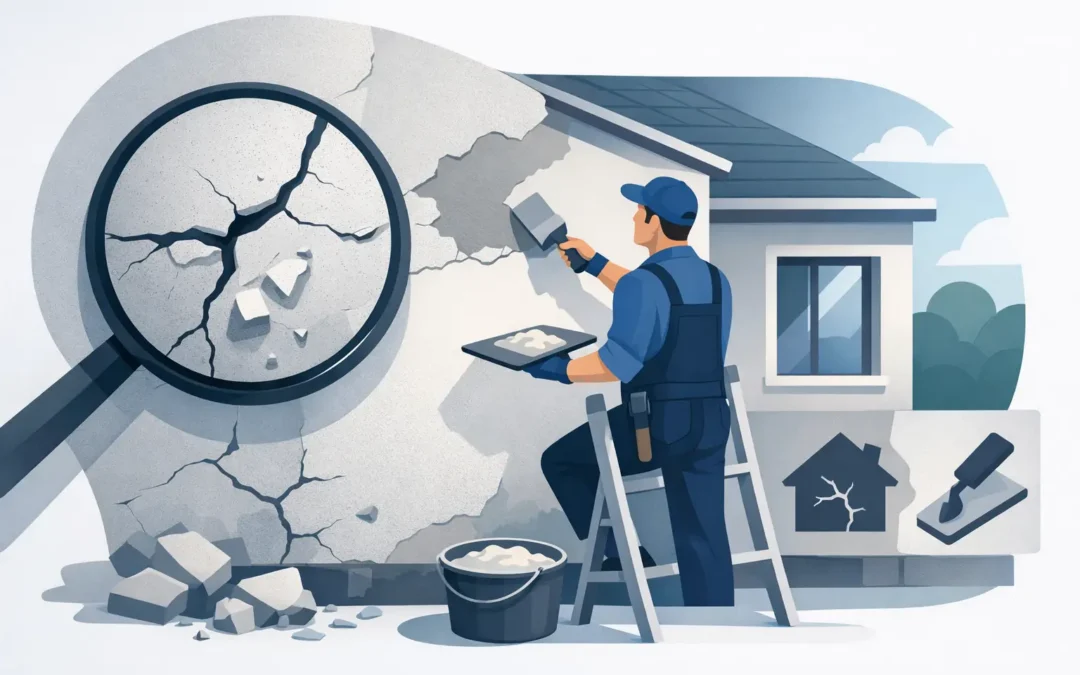
A hairline crack can be easy to dismiss, especially when the render still looks clean from the pavement. But render is your property’s weather-facing skin. Once it starts to split, water can find its way behind the finish, making a small cosmetic issue more expensive if it is left untreated.
If you are asking, why is my render cracking, the answer is rarely simply that the render is old. Cracks can result from movement in the building, poor preparation, trapped moisture, unsuitable materials or application in the wrong weather. The right repair depends on identifying the cause first, rather than just filling the visible line.
Why is my render cracking? Start with the crack type
Not every crack means the same thing. Fine surface crazing may be limited to the top layer of render, while a wider or repeated crack can point to movement in the wall beneath. Looking at the width, direction and location gives a useful first indication, but a proper inspection is the safest way to decide what is required.
Hairline cracks are often less than 1mm wide and may appear as a light network across an area of wall. They can occur when render dries too quickly or shrinks slightly as it cures. They still need attention, particularly on exposed elevations, but they do not always mean the render system has failed.
Straight vertical, horizontal or diagonal cracks deserve closer investigation. A diagonal crack running from the corner of a window or door, for example, may reflect stress around an opening or movement in the substrate. Cracks that are wide, deep, growing, or accompanied by loose render should not be treated as a simple decorating job.
Common causes of cracked render
Movement in the building
All buildings move to a degree. Seasonal temperature changes cause materials to expand and contract, while newer extensions can settle as they dry out and bed in. Older properties may also have a mix of brickwork, blockwork and previous repairs that respond differently over time.
Render has to accommodate this movement. If the system is too rigid for the background, lacks suitable reinforcement, or has been applied across movement joints without allowing for them, cracking can follow. This is one reason the same render finish is not suitable for every wall.
Structural movement is less common, but it must be ruled out where cracks are substantial, recurrent or visible internally as well as externally. Signs such as sticking doors or windows, stepped cracks in brickwork, and cracks that rapidly widen call for further professional advice before any render repairs begin.
Poor surface preparation
Good rendering begins with the wall beneath it. Dust, loose paint, failed old render, moss, salts and weak mortar can all prevent a new coat from bonding correctly. Applying render over an unstable surface may look fine initially, then crack or detach as the background deteriorates.
The substrate also needs to be suitably even and compatible with the chosen system. Patching isolated areas without properly preparing the edges is a common source of cracks. The repair and the surrounding render dry and move at different rates, leaving a visible line around the patch.
Incorrect mix, thickness or application
Traditional sand and cement render is particularly sensitive to mix proportions, coat thickness and curing. A mix that is too strong can be less flexible than the wall it sits on. A coat applied too thickly in one pass may shrink as it dries, causing cracking or crazing.
Modern coloured renders, including silicone, acrylic and monocouche systems, also have clear manufacturer requirements. They need the correct basecoat, mesh reinforcement, primer and finish applied in the right sequence. Using products from different systems without checking compatibility can compromise the finished wall.
A skilled renderer does not simply put material on the wall. They assess the background, manage thicknesses, reinforce vulnerable areas and allow appropriate drying time between stages. That preparation is what helps the finish stay sound through North West weather.
Drying too quickly or working in poor weather
Render needs controlled curing. Strong sun, wind or very warm conditions can pull moisture from fresh render too quickly, preventing it from curing evenly. Frost and heavy rain can be equally damaging, weakening fresh material before it has set properly.
The weather cannot always be perfect, particularly around Greater Manchester, Salford, Bolton and Bury. However, experienced contractors plan work around forecasts, protect fresh elevations where needed and do not force a finish in conditions that risk its performance. Rushing to complete a job can create problems that only become visible months later.
Water getting behind the render
Water is often both a cause and a consequence of cracking. A blocked gutter, leaking downpipe, damaged roof verge or failed seal around a window can repeatedly soak one section of wall. When water enters through a crack, freezes, or becomes trapped behind dense render, it can push the finish away from the substrate.
Look for staining, green growth, bubbling paint internally, soft patches, white salts or hollow sounds when the wall is lightly tapped. These signs suggest moisture needs dealing with alongside the crack itself. Repairing render without fixing the source of water usually leads to the same problem returning.
When cracked render needs urgent attention
A fine, stable crack can often be assessed and repaired before it develops further. However, act promptly if pieces of render are loose, the wall sounds hollow, cracks are wider than a hairline, or damp marks are appearing indoors. Safety matters too: loose render above a doorway, path or public pavement can fall without much warning.
It is also wise to seek advice where the crack crosses different materials, such as the junction between an extension and the original house, or where it follows a clear diagonal line from an opening. In these cases, covering the crack with sealant can hide evidence of movement without solving it.
Can cracked render be repaired without re-rendering the whole house?
Sometimes, yes. A localised repair can be a sensible and cost-effective option when the surrounding render is firmly bonded, the cause has been fixed, and the damage is limited to a small area. The loose material is removed back to a sound edge, the background is prepared, and the repair is rebuilt with compatible materials.
The trade-off is appearance. Matching the texture and colour of older render can be difficult, especially with coloured finishes that have weathered over several years. A patch may remain visible in certain light even when the repair is technically sound. Painting a full elevation can improve consistency where the render is suitable for coating, while more extensive failure may justify re-rendering that elevation.
Where cracks are widespread, hollow areas are present or the render has repeatedly failed, patching can become false economy. Removing the defective finish and installing a suitable new system is often the more dependable long-term choice.
The right way to repair a render crack
A lasting repair starts by finding out whether the crack is only in the finish or continues into the basecoat and wall beneath. Loose material should be removed, damp issues resolved and the substrate allowed to dry. Depending on the system and crack location, a flexible repair material or reinforced basecoat may be required before the final finish is applied.
Mesh reinforcement is especially useful around openings, joints and repaired sections because it helps distribute stress through the render layer. It is not a substitute for addressing structural movement, but it is an essential part of many modern render systems.
Avoid filling an exterior crack with ordinary interior filler or painting over it as a permanent fix. These products are not designed for prolonged rain, frost and thermal movement. The crack may disappear briefly, but water can still get behind the wall finish.
Preventing cracks in new render
The best prevention comes before the first coat is applied. Choose a render system suited to the wall construction, deal with damp and drainage issues, and ensure the substrate is clean, stable and properly prepared. Details around windows, doors, rooflines and pipework deserve particular care because they are common pressure points.
For insulation render systems, correct board fixing, reinforcement and beads are just as important as the decorative top coat. For coloured renders, following the complete recommended system helps retain both the finish and the manufacturer-backed performance expected from the product.
A crack is not always a sign that your whole exterior needs replacing. It is, however, a reason to look closely before another wet winter turns a manageable repair into wider damage. A straightforward inspection from a rendering specialist such as DecoRenders can establish what has failed, what is still sound, and the most sensible route back to a clean, weatherproof finish.
Recent Comments