
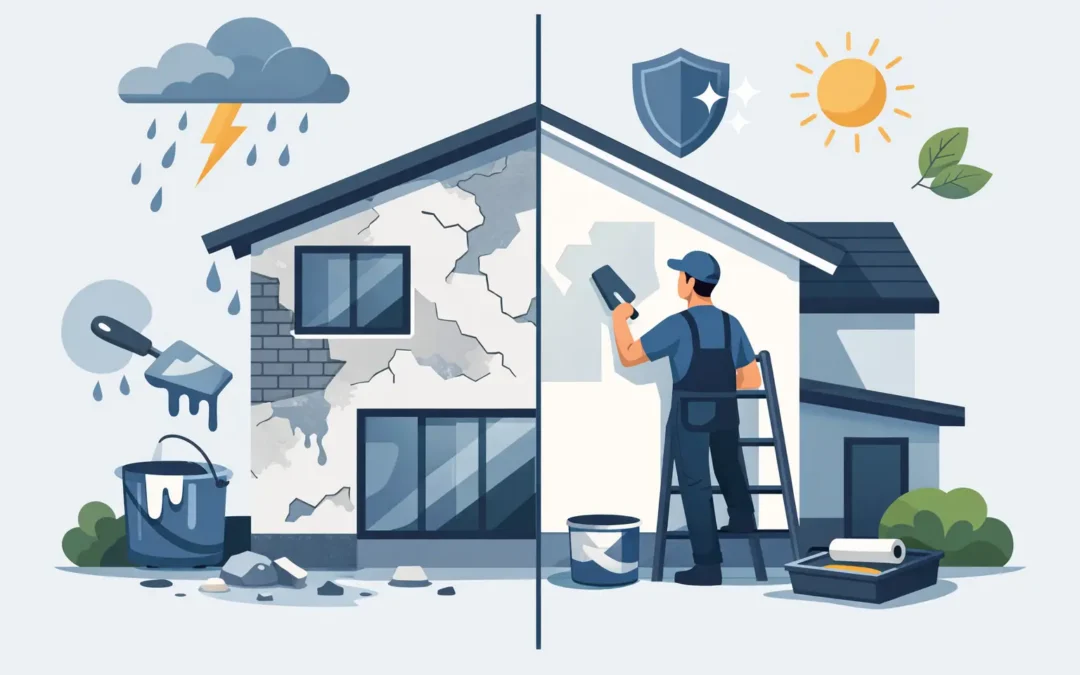
A crack in render is rarely just a cosmetic nuisance. It can be the first visible sign of moisture getting behind the finish, movement in the wall, or a system that was never properly matched to the building. Understanding why exterior render fails helps homeowners act before small defects become loose patches, damp internal walls or an expensive full replacement.
Render is expected to do a demanding job. It must protect masonry from rain, cope with changing temperatures, allow the wall to manage moisture appropriately and still look clean from the pavement. When it is specified and applied correctly, a rendered finish can last for many years. When one part of the process is rushed or overlooked, problems may show themselves surprisingly quickly.
Why exterior render fails: the common causes
Poor preparation of the background
A good render finish starts with the wall beneath it. Old paint, failed render, dust, algae, loose mortar and unstable brickwork all need attention before new material is applied. If render is applied over a weak or contaminated surface, it may not achieve a proper bond.
This often leads to hollow-sounding areas, cracking around edges or sections that begin to detach. It is tempting to render straight over a tired-looking wall to improve its appearance quickly, but covering a problem does not solve it. The background must be sound, clean and suitable for the chosen render system.
Different surfaces also need different preparation. Dense bricks, lightweight blocks, previously painted walls and external wall insulation systems do not behave in the same way. The correct primer, basecoat, reinforcing mesh and finish should be selected as part of one compatible system, rather than treated as separate products.
Moisture trapped behind the render
Water is one of the main reasons render deteriorates. Rain can enter through cracked coping stones, leaking gutters, damaged roof verges, poorly sealed window surrounds or faults at ground level. Once water gets behind the render, it can weaken the bond and create staining, blistering or blown areas.
In the North West, repeated wet weather makes good detailing especially important. A rendered wall needs properly formed drips, beads, seals and junctions so rain is directed away rather than allowed to sit on vulnerable edges. Render cannot compensate for a leaking gutter or a badly detailed roofline.
Moisture management is also about choosing the right material for the property. Some older solid-wall homes need a more breathable approach than modern cavity-wall construction. Applying an unsuitable, less vapour-permeable finish to a wall that already holds moisture can create problems indoors as well as outside. The best answer depends on the construction of the building, not simply the appearance required.
Cracks caused by movement
Most buildings move to some degree. Materials expand and contract with temperature changes, foundations can settle, and extensions may move differently from the original house. Small hairline cracks are not always a structural emergency, but they should not be ignored, particularly if they are widening, recurring or allowing water in.
Render is not designed to bridge significant movement without the right measures in place. Movement joints may be needed in larger areas, at changes in construction and around certain openings. Reinforcing mesh within a suitable basecoat helps distribute local stresses, but it will not cure ongoing structural movement.
Cracks around windows, doors and corners are particularly common because these are pressure points within a wall. Careful mesh placement and correct detailing reduce the risk. Where cracking is caused by a deeper issue, that issue should be investigated before the render is repaired. Otherwise, the new finish may crack in exactly the same place.
Incorrect mixing, timing or application
Rendering is skilled work because the material has to be applied at the right thickness, in suitable conditions and with proper curing time between stages. Adding too much water, mixing inconsistently, applying coats too thinly or too thickly, or working beyond the material’s recommended open time can all affect performance.
Premixed coloured render systems are often chosen for their clean, low-maintenance appearance, but they still rely on disciplined preparation and application. Colour and texture can vary if batches are not managed carefully or if work is stopped and restarted across a prominent elevation without planning. More seriously, poor application can reduce strength and adhesion.
A render system should be followed as specified by its manufacturer. Substituting products, missing out a primer or mesh layer, or treating drying times as optional may save time at the start but can shorten the life of the work considerably.
Weather conditions during the job
Fresh render is vulnerable while it cures. Very cold conditions can interfere with curing, while direct hot sun or strong wind can dry the surface too quickly. Heavy rain can mark, wash out or weaken uncured material. Frost is a particular concern because water within the render can freeze and damage the developing finish.
This does not mean exterior work is impossible outside the height of summer. It means the programme needs to respond to the forecast. Protection, sensible working hours and a willingness to pause when conditions are unsuitable are part of professional workmanship. A contractor who promises to render through any weather is not necessarily offering a better service.
Incompatible repairs and coatings
Many rendered properties have been patched or painted over the years. A repair made with a hard cement mix on a softer, older render can create a weak point. Similarly, coating breathable render with an unsuitable masonry paint may trap moisture or lead to peeling.
Before repairing a damaged elevation, it is worth identifying what is already on the wall. The right repair may be a local patch, a compatible coating, a new finish coat or, in severe cases, removal back to the substrate. There is no one-size-fits-all repair, and a neat-looking patch is not enough if it does not perform with the surrounding wall.
Warning signs that need attention
Not every mark means the render has failed, but certain signs call for a closer look. Hairline cracking can often be repaired if dealt with early. Larger cracks, hollow areas, crumbling edges, bulging sections, persistent damp patches and staining beneath gutters need a more thorough assessment.
Look closely around window reveals, ground-level sections, chimney breasts, roof junctions and the lower edge of the wall. These are common places for water to enter or details to fail. If you can tap an area and it sounds hollow compared with the surrounding render, the bond may have weakened.
Internal symptoms matter too. Peeling paint, cold damp patches or mould on the inside of an external wall may be linked to defects outside, though condensation and other causes should also be considered. A proper inspection looks at the building as a whole rather than assuming render is always to blame.
Repair or replace: making the right call
A small, isolated failure on an otherwise sound wall may only need a local repair. The damaged render can be removed, the background prepared and rebuilt using compatible materials. Matching texture and colour can be difficult on older finishes, so it is sensible to discuss what an acceptable visual result looks like before work starts.
Widespread cracking, repeated blown patches or signs of water damage across several elevations may point to a larger issue. In those cases, patching can become false economy. Removing failed material and installing a correctly specified new system gives the wall a more dependable long-term finish.
If energy efficiency is also a concern, external wall insulation with a render finish may be worth considering. It can improve the appearance of a tired façade while helping reduce heat loss. However, it changes details around windows, eaves, pipes and ground levels, so the design and installation must be carefully planned.
How to reduce the risk of render failure
The most reliable prevention begins before any render is ordered. Check the condition of brickwork, mortar, gutters, flashings and roof edges. Deal with leaks, rising damp concerns and structural movement first. A sound wall gives any finish a better chance of lasting.
Choose a system suited to the building and avoid selecting purely on colour or price. A modern coloured render can be an excellent option for many homes, while a more breathable system may be more appropriate for certain older properties. The finish should suit the wall, its exposure to weather and the level of maintenance you are prepared to carry out.
Finally, do not overlook aftercare. Keep gutters clear, repair damaged seals promptly and avoid fixing heavy items through render without proper details. A quick annual check, especially after winter, can catch minor issues before water has time to cause greater damage.
For property owners in Greater Manchester, Salford, Bolton and Bury, a close inspection by a specialist can replace guesswork with a practical repair plan. Whether the answer is a small compatible repair or a complete new finish, getting the cause right first is what protects the quality of the work for years to come.
Recent Comments