
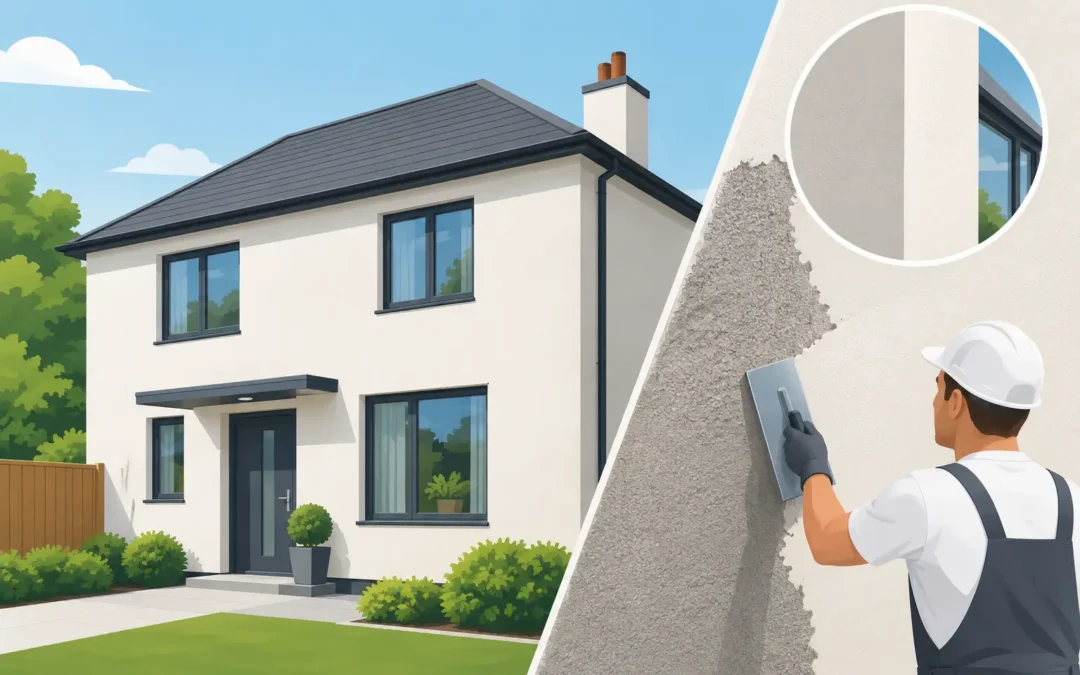
A useful Salford render example starts not with a colour chart, but with the wall beneath it. A property can look tired because of peeling paint, patchy repairs, cracked render or dark staining from years of rain. The right rendering work can make a major difference to its appearance, weather protection and value, but only when the system is matched properly to the building.
For many homeowners, the aim is straightforward: a clean, modern exterior that will stand up to Greater Manchester weather and does not become another maintenance problem in a few years. Getting there depends on careful preparation, sound materials and a finish applied with real attention to detail.
What a Salford render example should show
Imagine a typical brick semi-detached house in Salford with an older painted frontage. The paint has started to flake around the bay window, small cracks have appeared beneath the sills, and previous patch repairs are visible in different shades. The owner wants to improve kerb appeal while dealing with the underlying issues rather than simply covering them over.
The first step is a proper inspection. Loose material, failed coatings and damaged render need to be identified before a new finish is specified. If moisture is entering around a cracked sill, leaking gutter or poorly sealed pipe penetration, that fault should be put right first. Fresh render over an unresolved defect may look good initially, but it is unlikely to perform as it should.
Once the background is sound, the best route depends on the wall construction and the owner’s priorities. A breathable coloured render system may suit a solid wall that needs a smart, low-maintenance finish. If the property feels cold and heat is being lost through uninsulated external walls, external wall insulation with a render finish could be worth considering. It costs more than rendering alone and changes details around windows, doors and roof edges, but it can improve comfort as well as appearance.
A finish that looks right on the property
For this type of home, a light grey or soft off-white silicone thin-coat finish can give a crisp, contemporary result without making the frontage look out of place. Silicone render is valued for its water-repellent surface and vapour permeability. In simple terms, it helps rain stay on the outside while allowing the wall to release moisture vapour.
Monocouche render can also be an excellent choice where a through-coloured, more traditional rendered appearance is preferred. It is not a case of one product being automatically better than another. The right answer depends on the condition of the wall, exposure to weather, the desired texture and colour, and how the property is built.
Details make the difference. Clean lines around window reveals, straight corner beads, well-formed drip beads and neatly finished junctions stop a new façade from looking hurried. These are the parts people may not name, but they notice immediately when they are not right.
Preparation is the part that protects the finish
A render job is only as reliable as the surface it is fixed to. This is why a trustworthy Salford render example should show more than a polished after photograph. It should reflect the work carried out before the final coat is applied.
On a painted or mixed background, the existing surface may need to be removed, stabilised or covered with an appropriate basecoat and reinforcing mesh. Mesh helps distribute movement and strengthens vulnerable areas, particularly around openings where cracking is more likely. Corners, window heads and changes in background often need extra attention.
The wall must also be clean, stable and suitably level. If the background is badly uneven, applying a thin decorative coat will not hide the problem. Building up and levelling the surface correctly creates the foundation for an even finish.
Weather matters too. Rendering is not simply a dry-day job. Temperature, rain, wind and drying conditions all affect how materials cure. A professional team plans the work around suitable conditions and protects fresh render where needed. Rushing because a diary date is approaching is rarely a good trade-off.
Repairs should not be hidden
Older properties commonly have isolated cracks, hollow patches or areas where previous cement repairs are harder than the surrounding wall. These need an honest assessment. Some are cosmetic and can be dealt with as part of the preparation. Others may point to movement, damp ingress or failed building details that should be addressed before rendering.
This is one reason a site visit is more useful than a price based only on photographs. Photos can show the general look of a wall, but they cannot always reveal whether the old finish is securely bonded, how deep a crack runs or what is happening around a damp patch.
Insulated render changes more than the appearance
External wall insulation is often considered on solid-wall homes, extensions, garden rooms and properties that are difficult to keep warm. Insulation boards are fixed to the outside of the building, then reinforced and finished with a render system. The result can be a significant visual improvement, but the main benefit is the additional thermal layer.
There are practical points to resolve before choosing this option. Window and door reveals become deeper, external fittings may need moving, and roofline details need to accommodate the new wall thickness. On some homes, boundary space and planning considerations can also matter. A careful survey brings these issues to the surface early, rather than leaving awkward decisions once work has begun.
Where insulation is not required, a quality render-only system can still transform a property. It can cover tired brickwork, unify repaired areas and provide a durable coloured finish. The important thing is not to pay for insulation that offers little benefit to the building, or to choose a basic cosmetic solution when the wall genuinely needs more substantial work.
Choosing colour and texture with confidence
Colour choices have a bigger impact than most people expect. Bright white can look striking, but on a busy road or shaded elevation it may show dirt more quickly than a softer neutral. Very dark colours can look smart on a feature wall, although they may absorb more heat and should be selected with the system manufacturer’s guidance in mind.
Warm greys, off-whites and pale stone tones tend to work well across many Salford properties because they complement brick, slate roofs and existing boundary walls. The best choice is usually one that improves the house without fighting against its permanent features.
Texture is equally personal. A fine silicone finish provides a contemporary, even appearance, while a scraped monocouche finish has a different character and can suit a more traditional elevation. It is sensible to view physical samples in daylight. A colour can appear noticeably different between a small brochure image, a cloudy morning and direct sun.
What good rendering work looks like on site
A high-standard finish is not just about the final photograph. It also shows in how the project is managed. Windows, paths and surrounding areas should be protected properly. Materials should be kept organised, and the site should be left tidy at the end of the working day wherever possible.
Communication is part of the workmanship. Property owners should understand what is being done, why preparation is necessary and whether any unforeseen issue has been found. Rendering can uncover defects once old material is removed. The right approach is to explain the options clearly, including any additional cost or time involved, before proceeding.
At DecoRenders, this practical, owner-led approach is central to the work. A clean site, reliable attendance and close attention to the small details help turn a rendering project from a disruption into a worthwhile improvement.
Questions worth asking before you choose a renderer
Before accepting a quote, ask what preparation is included, which render system is proposed and why it suits your walls. It is also sensible to ask how cracks and weak areas will be reinforced, what protection will be used around windows and paving, and how weather conditions will be managed.
Ask to see examples of comparable work, particularly if your property has unusual details such as a bay window, a rendered extension joined to brickwork or difficult access. A good example should demonstrate neat finishing at edges and openings, not merely a flattering wide-angle picture.
Price matters, but a lower figure can leave out the work that gives render its lifespan: removing failed material, correcting defects, using compatible primers and mesh, and allowing enough time for proper curing. Clear scope is more valuable than a vague promise of a cheap finish.
A well-planned render project should leave you with more than a different colour wall. It should give your property a smart, properly protected exterior that feels cared for every time you arrive home.
Recent Comments