
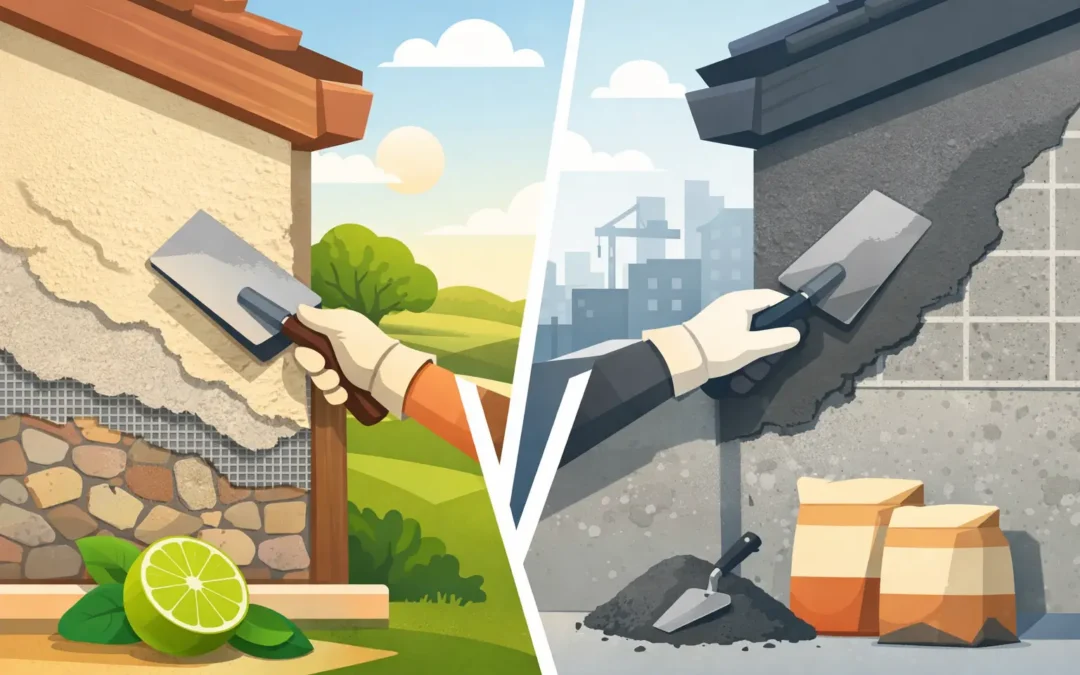
A cracked rendered wall is not always a rendering problem. On many older homes, it is a sign that the wall has been covered with a material that does not behave in the same way as the building beneath it. That is why the question of lime render versus cement render matters far more than appearance alone.
Both finishes can protect and improve an exterior wall when correctly specified and applied. The right choice depends on the property’s age, the wall construction, its condition, exposure to weather and the finish you want to achieve. Choosing purely on price or speed can create expensive repair work later.
Lime render versus cement render: the essential difference
Lime render is made with lime, sand and water, sometimes with carefully selected additives depending on the system. It is generally more flexible and more vapour permeable than cement-based render. In simple terms, it allows moisture within a wall to evaporate more readily.
Cement render uses cement, sand and water. It forms a harder, denser coat and has been widely used on properties throughout the twentieth century. It can provide a tough, neat surface, particularly on suitable modern masonry, but it is less forgiving of movement and less breathable than lime.
The key is not that one material is automatically good and the other automatically bad. It is whether the render works with the wall behind it. A solid brick cottage built before modern cavity walls needs a different approach from a newer block-built extension.
Why older solid-wall properties often suit lime
Many Victorian, Edwardian and older properties in Greater Manchester, Salford, Bolton and Bury have solid brick or stone walls. These walls absorb small amounts of moisture and need to release it again through the building fabric. They were often originally finished with lime mortar and lime render for this reason.
Applying a dense cement render to a traditionally built wall can restrict that drying process. If water enters through a crack, failed joint, leaking gutter or poor detail around a window, it may become trapped behind the render. Over time, this can contribute to damp patches, blown render, salt deposits and decaying brickwork.
Lime render is better able to accommodate minor movement and allows moisture to pass through it as vapour. It may develop fine, hairline surface marks over time, but these are not always a failure. Its relative softness is part of how it protects older masonry: the render can take the strain rather than forcing it into the bricks beneath.
That does not mean every older property must have lime render. Previous alterations, wall repairs, exposure levels and the condition of the masonry all need checking first. However, lime should always be seriously considered where a traditional, solid-wall building is being repaired or refurbished.
Where cement render can be the sensible option
Cement render is often appropriate on modern masonry walls designed for more rigid finishes. This may include certain blockwork extensions, newer homes and walls where a compatible modern render system is being installed over a properly prepared base.
It is hard-wearing and can be cost-effective for straightforward work. It also provides a familiar backing coat for some exterior finishing systems. When mixed correctly, applied at the proper thickness and protected with suitable detailing, it can give a durable result.
Problems usually arise when cement is applied too strongly, too thinly, on an unsuitable background or without addressing moisture issues first. A render coat cannot solve defective gutters, leaking pipes, failed flashings or rising ground levels. If those faults remain, even a good-quality finish is being asked to work under the wrong conditions.
Cement render also needs appropriate curing. Rapid drying, frost and poor site preparation can all lead to cracking or weak adhesion. Good rendering is not simply a case of putting material on a wall. The preparation, background assessment and finishing details make the difference between a tidy short-term result and one that lasts.
Breathability is about the whole wall, not just the render
“Breathable” is often used loosely in property discussions. It does not mean rainwater should pass freely through a wall. A properly finished lime-rendered wall should shed most rain while allowing trapped moisture vapour to escape gradually.
For this to work, the entire wall build-up must be considered. Impermeable masonry paint, cement pointing, internal tanking or blocked air bricks can undermine the benefits of lime render. Equally, a wall with a persistent leak needs repair before any new finish is applied.
The same principle applies to cement render. A dense finish on a modern cavity wall may be perfectly acceptable, provided the wall is in sound condition and the system has been specified for it. The material should suit the construction, rather than being chosen because it is what has always been used.
Appearance, texture and finish options
Lime render has a softer, more natural appearance that works particularly well on period homes, cottages and traditional elevations. It can be finished smooth, lightly textured or with a more characterful hand-applied surface. Its colour is often created with breathable mineral-based finishes rather than a standard masonry paint.
Cement render can be finished smooth or textured and is frequently painted after curing. It can also sit beneath decorative render systems, depending on the specification. For homeowners wanting a crisp, contemporary exterior, a modern coloured render system may be a better choice than either a traditional site-mixed lime or plain cement finish.
Appearance should never be treated separately from performance. A sleek, uniform finish is appealing, but the wall must be stable, dry enough and suitably prepared to hold it. The best results come from choosing a finish that complements both the style and construction of the property.
Cracking, repairs and long-term maintenance
No render is completely maintenance-free. Small cracks, impact damage and failed details around openings should be dealt with promptly, before water can travel behind the surface.
Lime render is generally easier to repair sympathetically because new lime can bond and work with the existing material. It is also less likely to damage soft historic brick if future repairs are needed. It does require patience, as curing times can be longer and correct weather conditions matter.
Cement render is harder and may resist everyday knocks well, but when it cracks or loses adhesion, the repair may need a larger area removed to reach sound material. If the wall behind is soft or damp, replacing failed cement with more cement may only repeat the same issue.
The condition of existing render also affects the decision. Removing old cement from fragile brickwork can be skilled, time-consuming work. In some cases, a careful assessment may show that selective repairs are appropriate; in others, full removal and a compatible new finish is the better long-term route.
Insulation changes the conversation
If the aim is to improve warmth as well as appearance, external wall insulation with a compatible render system may be worth considering. This is particularly relevant for solid-wall homes that feel cold or suffer from condensation on internal walls.
Insulation render systems are not a one-size-fits-all solution. Window reveals, roof edges, rainwater goods, ventilation and ground-level detailing all need planning. A good installation should look purposeful and neat, not like insulation has simply been added over existing problems.
For traditional buildings, the vapour performance of the full system matters. For newer properties, the focus may be on thermal improvement, impact resistance and achieving a low-maintenance coloured finish. The best specification begins with the wall, then works outward.
How to make the right choice for your property
Before deciding between lime and cement, establish what the wall is made from, whether it is solid or cavity construction, and why the existing render has failed. Check for damp sources, loose areas, cracks around openings, damaged pointing and any signs of movement. A render choice made without this groundwork is mostly guesswork.
It is also worth being clear about your priorities. If preserving a period property and protecting soft brickwork are central concerns, lime is often the stronger candidate. If you have modern masonry and need a durable base for an appropriate contemporary system, cement may be suitable. If insulation, colour and a clean modern finish are the goal, a specified external render system could be the most practical answer.
A careful site assessment is the useful starting point. Once the wall’s age, construction and condition are understood, the choice becomes much clearer – and the new finish has a far better chance of staying sound, dry and good-looking for years to come.
Recent Comments